
What Marquette County Property Tax Records Show
Marquette County splits parcel assessment from bill collection. Land Information maintains the tax parcels and the ownership link between them. The Treasurer builds the tax bills and tracks where each payment is routed. On the county portal, the detailed parcel card sits behind a login. So the exact field labels are best checked in the live system. What the county and state sources make clear is the vocabulary. A Wisconsin tax bill distinguishes assessed value, equalized value, and estimated fair market value. Each figure carries its own meaning. Knowing which label you are reading matters. It is the first step toward a sound conclusion about a property's tax status.
| Field | What It Shows | Where |
|---|---|---|
| Assessed value | Local parcel assessment used in the property-tax system | Land Information / assessor record |
| Equalized value and ratio | State comparison measure for municipal assessment levels | Wisconsin Department of Revenue |
| Estimated fair-market value | Value shown on the Wisconsin tax bill under the assessment manual | Assessment and tax-bill record |
| Tax bill and payment status | Installment, balance and delinquency information | County Public Portal / Treasurer |
| Special assessments and charges | Amounts that may become delinquent with unpaid tax | Tax bill and collecting treasurer |
An assessed value is not a recent sale price. Wisconsin's property assessment material spells out how local assessment, estimated fair-market value, and the assessment level relate to one another. Equalized value exists for comparison and tax apportionment across municipalities. It is not an appraisal of any single home. A bill can also add special assessments or special charges on top of the main tax amount, so read the line items before assuming the total is all property tax.
Marquette County's Nineteen Municipalities
The County Treasurer prepares bills for all 19 municipalities. Payments do not all go to one desk. A current-year payment made in December or January belongs to the local treasurer. The first installment falls due January 31. Pay it, and the balance can be postponed until July 31. That second installment goes to the County Treasurer. Delinquent taxes are also paid to the County Treasurer. This split is easy to miss near a city, village, or town line. Rely on the parcel's tax municipality, not the postal city printed on an envelope. For a current-year amount, read the county instructions. Confirm the receiving office before sending anything. The county's Treasurer tax page lays out the installment route and payment rules.
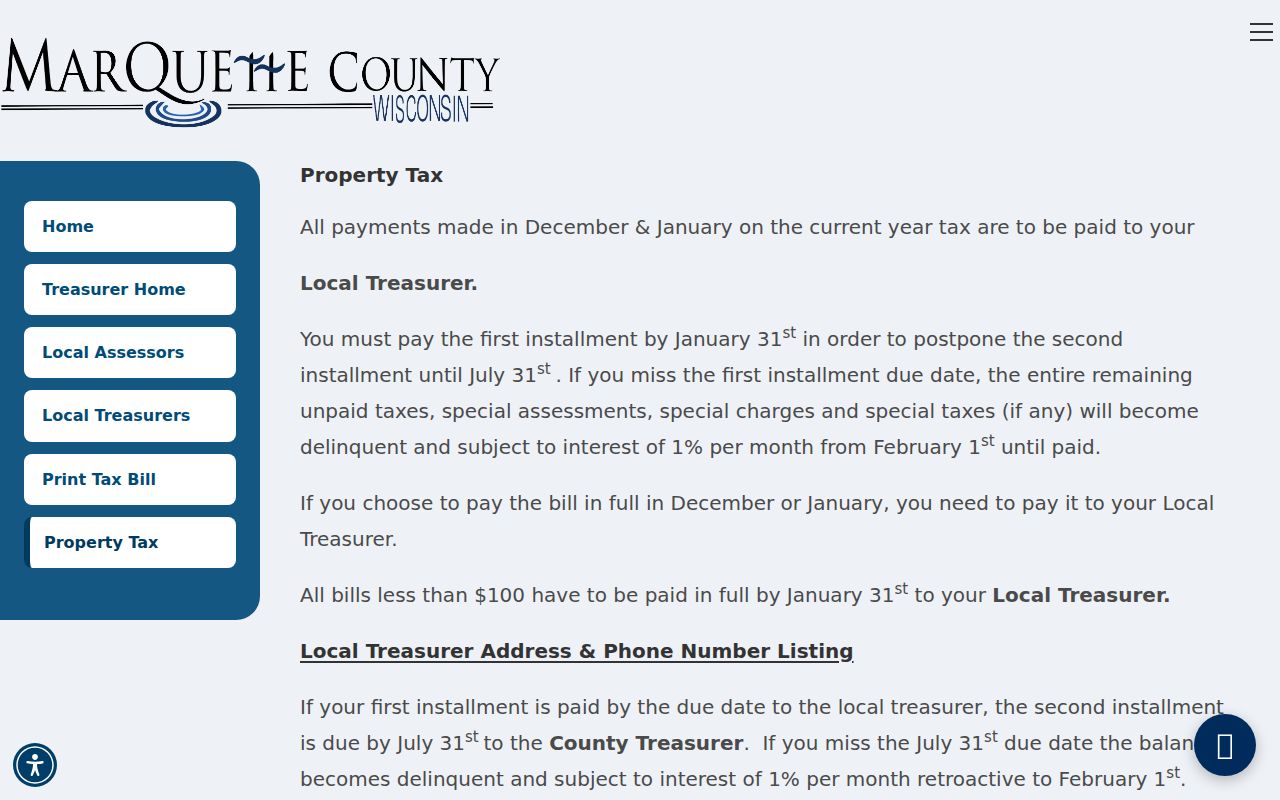
Keep the bill and payment receipt with the parcel number. That way the payment can be matched to the correct tax account without guesswork.
Use the Taxes Tab for Bills
The county's bill-print instructions follow a set sequence. Accept the portal terms and search for properties. Then choose the Taxes tab beside Property. Select Print Tax Bill from there. A pop-up may be needed to open the bill. Those directions describe the portal after terms acceptance. The LandNav endpoint, though, opens with a login screen for anonymous visitors. Treat the documented tabs as the route to follow once you are signed in. They are not controls visible on the current login page. If access stops at login, call the Treasurer at 608-297-3030 for payment questions. Call Land Information at 608-297-3029 for parcel-system help. The county Public Portal is the listed property entry point. It does not replace the local treasurer for a first current-year payment. It also does not replace the county for delinquent balances. The county's bill-print directions show the named tabs and the print control.
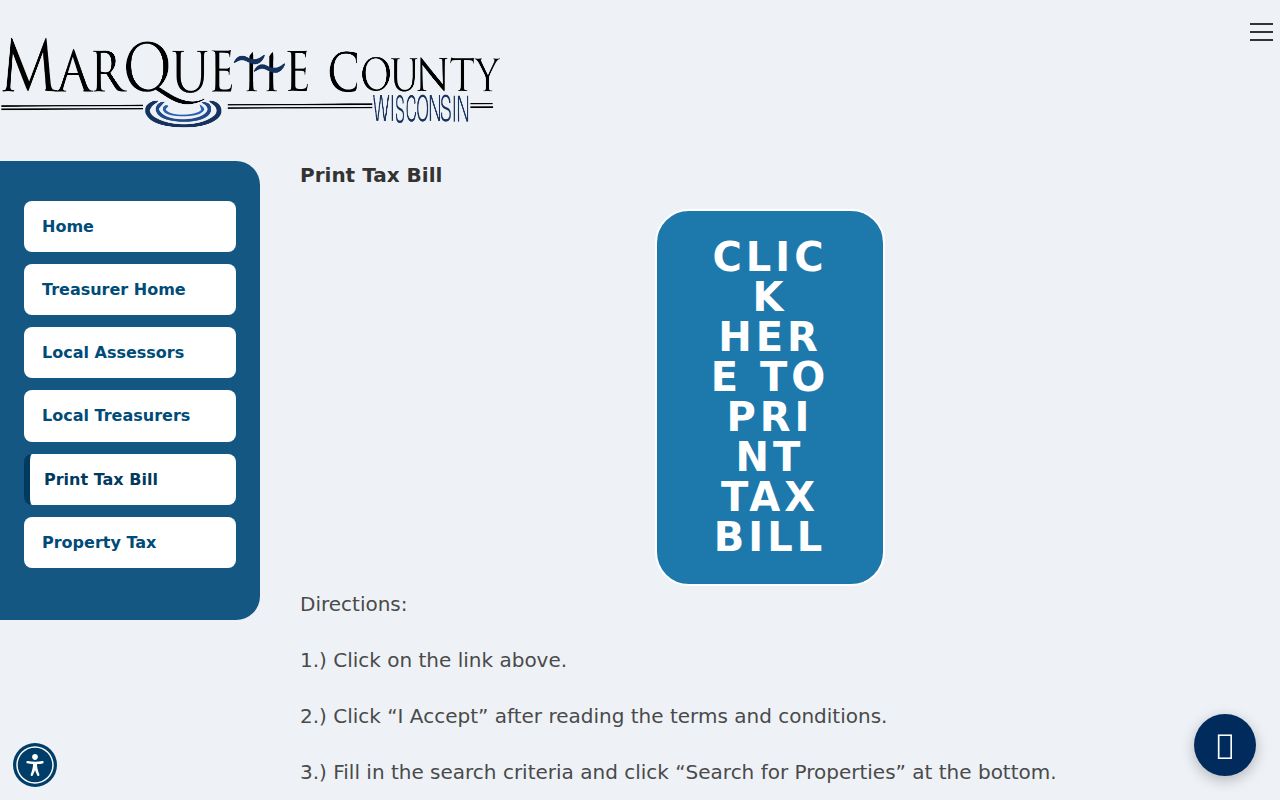
The screenshot captures the written steps, not an authenticated bill result.
Looking Up a Marquette County Tax Bill
Start with the address or parcel identifier. Confirm the tax municipality. Then open the bill. The county portal is linked from the Treasurer's instructions, but an anonymous visitor may meet a Catalis login. If so, call the office rather than guessing at a balance or sending a payment to the wrong desk. The Treasurer's duties include collecting delinquent and postponed real-estate taxes, so that office is the right call for past-due amounts.
- Follow the county’s portal link and accept the terms if the search page is available.
- Search by the property information accepted by the live portal and verify the municipality and parcel.
- Open Taxes, then Print Tax Bill; allow a pop-up if the bill window is blocked.
- For a balance or payment destination that is unclear, ask the local treasurer or County Treasurer.
- Assessed value
- The value assigned to a parcel in the local assessment roll.
- Equalized value
- A state measure used to compare local assessment levels.
- Delinquent tax
- A tax balance that has passed the county’s stated payment date.
- Tax-deed land
- Property involved in the county’s tax-deed process; check current notices and title instruments.
Delinquent Tax in Marquette County
Miss the first installment and the unpaid balance becomes delinquent. Special assessments, special charges, and special taxes become delinquent too, under the county's stated rules. Interest runs at 1% monthly from February 1. Missing the July installment makes the balance delinquent as well. Interest is applied retroactively to February 1. Bills under $100 must be paid in full by January 31. These dates matter. An amount due can change after the bill is printed. All delinquent taxes are paid to the County Treasurer. The office is at Room 102, 77 West Park Street, Montello, 608-297-3030. A current bill is not a title search. A property may be in a tax-deed process. Check the county's current notices and recorded instruments. The county publishes no complete current sale list or redemption calendar.
Assessed and Equalized Values
Wisconsin separates a parcel's local assessment from equalized value and the assessment ratio. The Department of Revenue explains the division of labor. Local assessors value property. The state calculates equalized values for municipal comparison. The assessment level is a ratio of local assessed value to equalized value. A state guide also describes estimated fair-market value on tax bills and the five-year compliance rule in the Property Assessment Manual. Use each value for its own purpose. A parcel's assessed value is part of the local property-tax record. Equalized value is not an asking price for a single home. For the parcel's bill amount, use the tax record. For the meaning of the value figures, see the Marquette County property value explanation. The state's Open Book and Board of Review calendar lets owners select the relevant municipality.
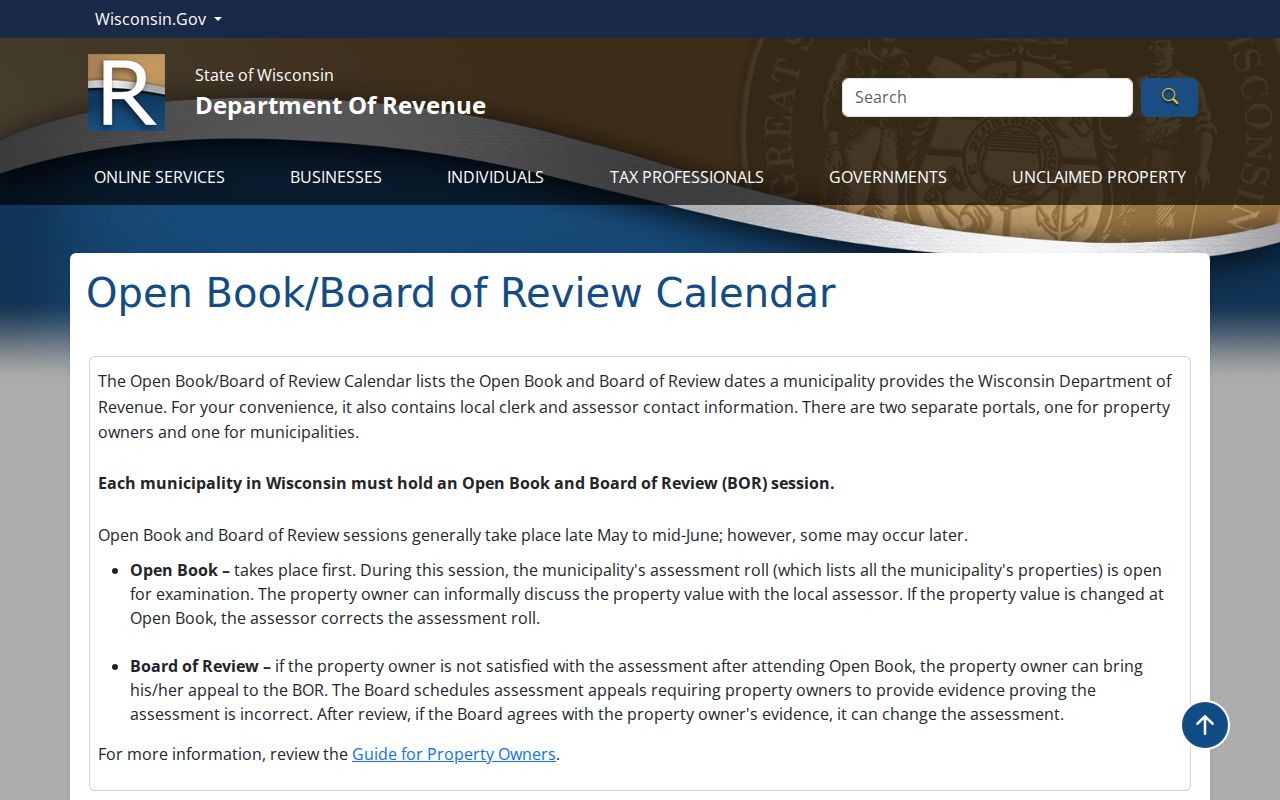
Use the municipality-specific listing because the county covers several local assessment jurisdictions.
Open Book and Board of Review
Wisconsin gives property owners two chances to question an assessment. First comes Open Book. That is an informal session with the local assessor. An owner of record can look over the parcel details and point out errors there. The second step is the Board of Review. That formal body hears objections and can change the assessed value. Dates vary by municipality. Marquette County sets no single countywide appeal date that covers every parcel. Each town or village follows its own calendar.
The Department of Revenue publishes a searchable calendar. Owners can look up Open Book and Board of Review dates by municipality there. Watch the local notice for the schedule and filing instructions. A deadline from another town or village will not apply to your parcel. Gather the assessment notice, the property characteristics on record, and any relevant sale information before filing. The Department of Revenue's Guide for Property Owners explains the objection process. It also covers each review step in plain terms.
One habit helps. Check the state calendar again whenever a new assessment notice arrives. Municipal dates shift from year to year, and the Board of Review window can be short.
Appealing a Marquette County Assessment
To contest an assessment, use the Open Book and Board of Review process for the municipality where the parcel sits. Check the local calendar first. Also watch for the assessor or clerk notice. The state process and calendar govern every jurisdiction, though no single countywide deadline applies. Keep the assessment record and parcel description together. Add supporting sale or property information, then follow the local filing directions for the year at issue.
Appeal window. Marquette County review dates are municipality-specific. Select the correct municipality on the Wisconsin Department of Revenue calendar and confirm the filing steps with the local assessor or clerk; no universal county deadline is published.